

I once watched a high-powered executive – someone who managed substantial amounts in assets – literally forget how to breathe during a coaching session. Not metaphorically. She had become so disconnected from her body after decades of “neck-up” leadership that when asked to take a deep breath, she moved her shoulders up and down while barely inhaling. This moment crystallized for me how far we have traveled from our wholeness in pursuit of professional success, and why the evolution of coaching toward more integrated and holistic approaches isn’t just timely. It is absolutely essential.
The landscape of professional and executive coaching has undergone a remarkable metamorphosis since its emergence in the late 20th century; I have witnessed many of these changes in my 26+ years of coaching. What began as a performance-oriented practice borrowed from sports – essentially “business athletics” focused on winning the corporate game – has evolved into something far more nuanced and, dare I say, more human. Today’s most innovative coaches are abandoning the fiction that we can separate our professional selves from our bodies, our environment, and our ancestral wisdom. They are embracing somatic awareness, partnering with nature as co-coach, and humbly learning from ancient traditions that have guided human development for millennia. These aren’t just trendy additions to make coaching feel more “woo-woo” (though that accusation certainly gets thrown around). They represent a fundamental recognition that we have been trying to solve multidimensional problems with one-dimensional tools.
The Traditional Foundation: When Coaching Wore a Suit and Tie
Professional coaching as we know it emerged in the 1980s and 1990s, born in the fluorescent-lit conference rooms of corporate America. Early executive coaching was essentially business consulting’s younger, more emotionally available sibling. It drew heavily from organizational psychology, performance management, and just enough sports psychology to make executives feel like corporate athletes. The focus was laser-sharp: achieve specific goals, improve metrics, climb ladders (corporate ones, not actual ladders; that would come later with nature-based coaching).
I will admit there is something almost quaint now about those early days when coaches believed that a good SMART goal and an accountability structure could solve most problems. We wielded our 360-degree feedback assessments like sacred texts, our Myers-Briggs types like astrological signs for the business world. “Oh, you are an INTJ? That explains everything!” We created action plans with the optimistic certainty of someone who has never tried to change a deeply ingrained pattern.
Yet, let’s be honest – this traditional approach worked. Sort of. It helped countless professionals navigate transitions, develop skills, and achieve tangible results. The International Coaching Federation, founded in 1995, brought legitimacy and standards to what could have remained the Wild West of professional development. We learned to ask powerful questions instead of giving advice (mostly), to hold space instead of filling it with our own agenda (usually), and to believe in our clients’ potential even when they couldn’t see it themselves.
But here is what we missed in those early days: humans aren’t machines that can be optimized through better programming. We are infinitely more complex, embodied, culturally embedded beings living in a more-than-human world. The cracks in the purely cognitive coaching model became impossible to ignore when clients would achieve all their goals yet still feel empty, when brilliant strategies would collapse under the weight of unprocessed emotions, when the most successful leaders were also the most disconnected from themselves and others.
The Somatic Revolution: Coaches Are Discovering That Leaders Actually Have Bodies
The integration of somatic coaching into the field represents nothing less than a revolution, though perhaps “reunion” would be more accurate. After all, we are simply remembering what every indigenous and ancient culture has always known: the body holds wisdom that the mind alone cannot access.
Somatic Coaching emerged from a beautiful collision of neuroscience, trauma therapy, mindfulness practices, a variety of movement modalities, and the revolutionary idea that maybe, just maybe, that tension in your shoulders during board meetings is trying to tell you something important. This approach recognizes that our bodies are not just an organic vehicle carrying our precious brains around (though I have met leaders who seemed to operate on this assumption). Rather, our bodies are integral to how we perceive, decide, and lead.
I remember working with a CEO who intellectually understood that she needed to delegate more but couldn’t seem to actually do it. We had talked it through from every angle – the business case, the team development benefits, the time management advantages. Nothing shifted until we explored how her body literally contracted when she considered letting go of control. Her shoulders would rise, her jaw would clench, and her breathing would become shallow. These weren’t just reactions to the idea of delegation; they were embodied memories of childhood experiences where letting go meant chaos and danger.
Working somatically, we didn’t just talk about trust; she learned to experience trust in her body. She practiced breathing into expansion, softening her grip (literally and figuratively), and noticing the difference between vigilance and awareness. The shift was profound, and not only because she gained new information, but because she developed a new way of being in her body that made delegation possible.
The neuroscience behind this is fascinating and vindicates what practitioners have observed for years. Our vagus nerve, that wandering messenger between body and brain, carries about 80% of its signals upward from body to brain, not the other way around. Our gut literally has its own neural network – the enteric nervous system – often called our “second brain” (though given its evolutionary precedence, perhaps our gut should file a complaint about being labeled “second”). When we ignore these embodied sources of information, we are essentially trying to lead with 20% of our available data. And then, of course, there is also the heart.
Nature as Co-Coach: When Trees Became Guides
If bringing the body into coaching was revolutionary, inviting nature as co-coach might be downright radical. Yet this movement toward nature-based coaching reflects both ancient wisdom and urgent contemporary need. We are, after all, facing the minor detail of ecological collapse while most leadership development still happens in windowless rooms with recycled air and fluorescent lighting that makes everyone look slightly ill.

After I finished my Ph.D. in Applied Eco-Psychology, I was somewhat reluctant about bringing it into the corporate world. Sure, it worked well in my retreats and teaching programs, because I contextualized it with humour, likely blended with my own lack of confidence (saying that, “Eco-Psychology means that I can hug trees professionally, unlike all the other ‘amateurs’ out there”). It changed the first time I decided to not hold back, facilitating a session with a leadership team in a forest during autumn. We were exploring themes of transition and letting go – topics that had felt abstract and threatening in the boardroom. But surrounded by trees freely releasing their leaves, trusting in the cycle of renewal, something shifted. One particularly resistant executive actually laughed and said, “The trees aren’t having an existential crisis about dropping their leaves. They just know it is time.” That insight, delivered by a maple tree, created more movement than months of traditional coaching had achieved.
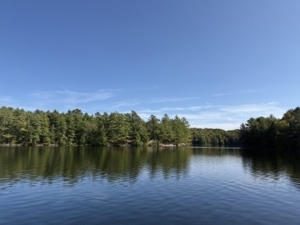
I recently co-facilitated a retreat with David Graham, a friend and a professional collaborator, for The Coach Collective in the beautiful region of Muskoka lakes, several hours north of Toronto. David is a big believer in the power of transformational experiences, by taking leaders and their teams out of the boardroom and into nature. He recently delivered a TEDx talk, “Why your best ideas don’t happen in the office,” sharing what he has discovered about how leaders gain new insights when he takes them and their challenges into nature. The clarity that emerges from these experiences is often astonishing. Our retreat was focused on Nature Coaching and Somatic Coaching, and it was beautiful to observe and experience these two areas being very close siblings; after all, being really present and open to the world around us requires, first and foremost, being present to ourselves.
The research supporting nature-based coaching is robust and growing. Studies on shinrin-yoku (forest bathing) show measurable decreases in cortisol, reductions in sympathetic nervous system activity, and improvements in immune function. But beyond these physiological benefits, nature offers something harder to measure but equally valuable: perspective, humility, and a reminder that we are part of something infinitely larger than quarterly earnings reports.
Integrating Indigenous Wisdom: The Humbling Recognition That We Knew Better 10,000 Years Ago
The integration of indigenous wisdom into coaching is another profound and challenging evolution in the field. It requires those of us trained in Western modalities to admit that our “innovative” discoveries are often pale imitations of practices indigenous peoples have refined over millennia. It can be humbling to realize that while we were creating personality assessments, indigenous cultures had developed sophisticated practices for understanding human nature that consider ancestry, community, land, and spirit.
Indigenous wisdom brings perspectives that fundamentally challenge the assumptions underlying traditional Western coaching. The emphasis on individual achievement? Indigenous traditions understand that individual wellbeing is inseparable from collective health. The linear progress narrative? Indigenous cultures recognize circular time, seasonal rhythms, and the spiral nature of growth. The separation of professional and spiritual development? Many indigenous traditions would find this division both artificial and harmful.
But here is where we must tread carefully, with the kind of respect that has been notably absent from centuries of colonial extraction. The integration of indigenous wisdom into coaching cannot be another form of appropriation, where we cherry-pick practices divorced from their cultural context, slap a trademark on them, and sell them as the latest coaching innovation (I am looking at you, everyone who has ever offered “shamanic coaching” after a weekend workshop).
Real integration requires relationship, reciprocity, and respect. It means learning from indigenous teachers, compensating them fairly, and understanding that some practices are not meant for commodification. It means acknowledging the historical and ongoing harm colonization has caused and considering how coaching might participate in repair rather than perpetuating extraction.
When done with integrity, the integration of indigenous wisdom offers profound gifts. The Haudenosaunee principle of seven-generation thinking transforms how we consider impact and legacy. Ubuntu – the Southern African philosophy that “I am because we are” – revolutionizes our understanding of individual development. The medicine wheel teachings offer frameworks for understanding wholeness that make our four-quadrant models look like stick figures.
During the retreat, I started a rich and insightful conversation with one of the participants, Sharon Pitawanakwat, who is a coach and an indigenous leader, that continued to deepen long after our in-person time together ended. Sharon brings a rare and powerful blend of Indigenous and Western knowledge to her work with clients and organizations. For her, coaching presence means welcoming both worldviews into every sacred conversation she holds. Her ancestral wisdom isn’t a tool she reaches for when needed – it is the ground of her being, shaping how she listens, perceives, and connects. Through this integrated way of seeing, Sharon recognizes the web of interconnectedness in all her dialogues, helping clients weave their own discoveries into a living tapestry of self-awareness and understanding.
The Enneagram: When Ancient Wisdom Meets Modern Psychology (and They Really Hit It Off)
Before we explore how all these streams converge, we need to talk about a framework that has revolutionizing how coaches understand human patterns, motivations, and potential: the Enneagram. Now, I know what some of you are thinking – “Oh great, another personality typing system. Is this like Myers-Briggs but with more spiritual bypassing?” Stay with me here, because the Enneagram is something altogether different and far more profound; what follows is a brief review, for context.
Unlike personality assessments that slot you into a fixed category (Congratulations! You are a Type A go-getter! Here is your certificate!), the Enneagram reveals the underlying motivational patterns that drive our thoughts, feelings, and behaviours. It is less about what you do and more about why you do it – the core fears and desires that operate like invisible puppet strings, making you dance the same patterns over and over until you become conscious of them.
What makes the Enneagram particularly powerful for transformation is that it doesn’t simply describe your personality; it shows you the box you are trapped in and hands you a map for getting out. Each of the nine types represents a different way of losing contact with our essential nature, a different flavour of forgetting who we really are. And here is the kicker – your type is both your greatest strength and your most persistent prison. It is THE LENS through which you see everything, so invisible to you that you mistake it for reality itself.
I once worked with a Type Three executive who had built an empire but couldn’t figure out why success felt so empty. Through the Enneagram lens, she recognized that she had been shapeshifting her entire life, becoming whatever would earn approval and admiration. The profound moment came when she realized she had no idea who she was beneath all the achieving. “I am like an Oscar-winning actress who forgot she is simply playing a role,” she said, and then burst into tears – probably the first authentic emotion she had shown in a boardroom in decades.
The Enneagram’s power lies partly in its integration of multiple wisdom streams. Its roots trace back through Sufi mysticism, Christian contemplative tradition, and ancient Greek philosophy (those Pythagoreans were onto something). Yet it also incorporates modern psychological insights about defense mechanisms, attachment theory, and cognitive patterns. It is like someone created a framework that Jung, Rumi, and your wisest grandmother would all nod approvingly at.
Here is where it gets really interesting for coaching: the Enneagram is inherently somatic. Each type has characteristic body patterns, like the Eight’s expanded chest and forward-leaning intensity, the Five’s contracted pulled-back energy, the Seven’s upward-lifting enthusiasm that barely touches the ground. When you help clients recognize these somatic patterns, transformation moves from intellectual understanding to embodied awareness. A Type One doesn’t just understand their perfectionism intellectually; they feel the chronic tension in their jaw and shoulders, the held breath of constant vigilance against making mistakes.
The Enneagram also provides a roadmap for growth that aligns beautifully with nature’s wisdom. It teaches that growth isn’t about becoming a different type (sorry, you can’t trade in your Six for a Seven, no matter how fun they look at parties). Instead, it is about relaxing the grip of your type’s fixation, integrating the healthy qualities of all nine types, and moving toward what the tradition calls your “essence” – who you are beyond personality’s constraints. Who you have always been, before you started believing the whispers of the defense mechanisms of your personality.
I have seen the Enneagram create breakthrough moments that years of traditional coaching couldn’t achieve. A Type 9 finally understanding why they constantly disappeared themselves to avoid conflict – and suddenly having permission to take up space. A Type 4 recognizing their addiction to melancholy as a misguided attempt to feel special – and discovering that ordinary happiness doesn’t make them ordinary. A Type 2 realizing their compulsive giving was actually a covert contract for love – and learning to receive without earning it first.
The Convergence: When All the Streams Meet and Throw a Party


This integral approach recognizes what mystics, poets, and indigenous elders have always known: transformation isn’t a linear process that happens in one dimension. It is multidimensional, mysterious, and often happens in the spaces between things – between breath, between thoughts, between self and other, between human and nature.
I have witnessed this convergence in action with a tech executive struggling with burnout and meaning. Traditional coaching had helped him optimize his schedule and delegate better, but the emptiness persisted. Working holistically, we began by exploring his Enneagram type (an 8 who had been running on willful and forceful energy so long he had forgotten what peace felt like). Understanding his type’s core fear of vulnerability and control helped him recognize why he had built such impressive armour, and why that armour had become his prison. We then moved to somatic practices, helping him sense where that type 8 energy lived in his body – the chronic forward thrust, the hardened belly, the chest puffed with false invulnerability. We took sessions outdoors, where he could witness nature’s power that didn’t require dominance, like the quiet authority of an ancient oak, or the gentle persistence of water carving stone. We explored his cultural heritage and the wisdom traditions of his ancestors, discovering practices that resonated with something deeper than his MBA training could touch. The Enneagram became not merely a map but a gateway to understanding how his personality had both served and limited him.
The transformation wasn’t merely personal. He began leading differently, instituting “embodiment breaks” in meetings, moving team retreats outdoors, and bringing indigenous principles of reciprocity into corporate strategy. His company’s approach to sustainability is in the process of shifted from compliance to genuine relationship with the land they operated on. The ripple effects continue expanding.
The Shadow Side: When Evolution Gets Messy
Let’s be honest about something the coaching industry doesn’t always acknowledge: this evolution isn’t universally celebrated. For every coach embracing somatic awareness, there is another rolling their eyes at what they see as “fluffy” additions to serious business coaching. For every organization investing in nature-based leadership development, there are dozens dismissing it as expensive “camp for adults.” The Enneagram? I have heard it called everything from “corporate astrology” to “narcissism enablement system” (though usually by people who haven’t moved beyond surface-level understanding). And the integration of indigenous wisdom triggers everything from cultural anxiety to outright hostility in spaces still dominated by colonial mindsets.
There is also the risk of superficial adoption, like coaches who add “somatic” to their website after reading one book, nature-based coaches who are really just having outdoor meetings, Enneagram “experts” who treat types like horoscopes rather than gateways to transformation, and the problematic appropriation of indigenous practices mentioned earlier. The evolution of coaching requires depth, study, and humility – qualities not always abundant in a field that attracts its share of ego-driven practitioners convinced they have all the answers (ironically, often the very pattern their Enneagram type would predict).
Conclusion: The Future Is Ancient, Modern, and Integrated


The challenges facing humanity – climate chaos, systemic inequality, meaning crises, technological disruption, ego and power that run unchecked – cannot be solved by minds disconnected from bodies, humans separated from nature, or individuals isolated from community wisdom. We need leaders and coaches who can dance between worlds, who can hold complexity without collapsing into simplicity, who can honour both spreadsheets and ceremony, who can be professionally excellent while remaining humanly whole.
The future of coaching lies not in new technologies or methodologies but in remembering ancient truths: We are embodied beings, not floating heads. We are nature, not separate from it. We are interconnected, not isolated units. We are patterns seeking transformation, not fixed personalities seeking optimization. And perhaps most importantly, the wisdom we seek has always been available – in our bodies, in the natural world, in the traditions of peoples who never forgot what we are only now remembering, and in frameworks like the Enneagram that show us both our prisons and our keys.
As coaching continues this evolution, may we have the courage to release what no longer serves (including the grip of our personality patterns), the humility to learn from sources our training didn’t validate, and the wisdom to know that transformation – real transformation (what I call “awakening”) – requires all of us: body, mind, spirit, community, and the more-than-human world that holds us all. May we use tools like the Enneagram not to box people in but to help them discover the door they have been standing next to all along.