

Who doesn’t love books. The Library of Professional Coaching offers a bookstore that is filled with books on coaching that can be purchased at a very reasonable price. Here is a link to this bookstore:
Then there is the matter of getting these same books in digital form at no cost to you. And who doesn’t love free books? Due to the generous donations of these authors, you are able to download several entire books at no cost for the digital, PDF versions. Watch this space as we will add more books over time. You may wish to bookmark this page to return to for more free books.
_________________
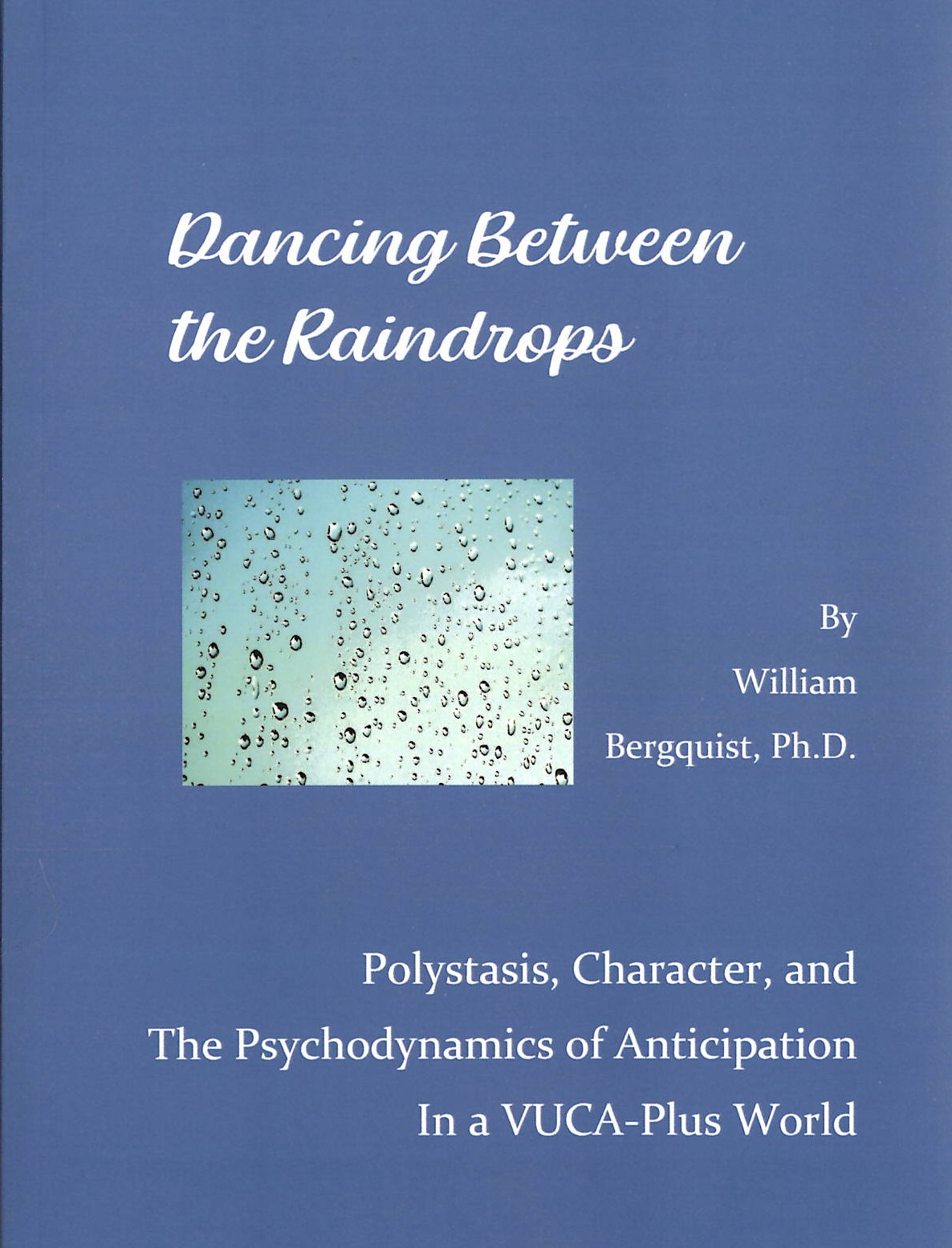
Dancing Between the Raindrops: Polystasis, Character, and the Psychodynamics of Anticipation in a VUCA-Plus World
Preview
We are living in a society that confronts us every moment with raindrop challenges—be they environmental, economic, or political. Somehow, we have to live and work around these challenges, rather than being trapped or frozen in anxiety and despair regarding the conditions in which each of these challenges now operates. Conditions such as volatility, uncertainty, complexity, ambiguity, turbulence, and contradiction.
In essence, complexity (C) concerns the many elements and dynamic interaction among elements that have to be considered, while Volatility (V) refers to the rate and shifting rate of change among the elements. The other two terms have to do with epistemology (acquisition of knowledge and definition of reality). Ambiguity (A) concerns the assessment of both the evidence available regarding reality and the meaning assigned to this reality. The fourth term, Uncertainty (U) concerns the stability of any assessment made about reality. Does reality change over a short period of time? Why do an extensive assessment if our world is constantly shifting? VUCA is deservedly becoming the coin of the realm among contemporary organizational and societal analysts.
I add two other conditions that are prevalent in mid-21st-century life. They are turbulence and contradiction (the “plus” in VUCA-Plus). Some things are rapidly moving, while others are engaged in cyclical movement under turbulent conditions. Other things are not moving at all or moving chaotically. The systemic Impact concerns the operations of a world in which four systems operate simultaneously. These four systems create the “white water” world prevalent in mid-21st-century societies (Vaill, 1989/2008). Navigation of a white-water environment requires an ongoing search for balance and direction, which in turn requires ongoing attention to the shifting conditions of this environment.
Contradiction is to be found at every corner of our mid-21st-century societies. We find this condition existing in contradictory advertisements for health-style remedies, romantic getaways, and many pathways to happiness. Even more profound sources of contradiction are found in politics and social policy. We often face a choice between two options, each with both an upside and a downside. Furthermore, the achievement of one is likely to reduce the achievement of the other. Our governmental leaders solve a major social problem. In doing so, they increase the national debt. The need for control of pornography on the Internet is great, but so is the need for an Internet that is free of constraints and values imposed by one group of “believers.”
In the rainy weather of mid-21st-century life, we face many difficult choices that often lead to negative outcomes in our personal lives and our collective lives.
I propose in this book that we can “dance” around these big raindrops by embracing a dynamic, feedback process that I have identified as Polystasis. Unlike the usual pull toward return to a state of homeostasis, I am proposing that we have the opportunity to live with and even survive in a state where the baseline is always changing (Poly-stasis), and where we are guided by a psychosocial template that provides us with guidance as we receive and respond to feedback from the VUCA-Plus world in which we are operating.
Polystasis blends the concept of Statics (stabilizing structures) with that of Dynamics (adaptive processes). Operating in human systems, we are guided by certain core outcomes that do not readily change (statics); however, we must also be open to modifying these guiding outcomes as our environment changes. The static notion of homeostasis is inaccurate—especially when applied in our VUCA-Plus environment. It is in our attunement to feedback arriving on an ongoing basis from the world in which we live that we can be adaptive and can “learn into the future” (Scharmer, 2009). We can anticipate the rain and prepare to dance around the raindrops . . .
As a psychologist who has been influenced by the Neo-Freudian theories of those aligned with ego psychology and those operating from an object relations perspective, I believe that Polystasis involves both the brain and heart. Both cognition and emotions. The interweaving of thinking and feeling. I am particularly intrigued with the recent “discovery” that regret might be a more motivating emotion than either gain or loss. We try to avoid making any decision that we will later regret. We hate to miss an “opportunity” or to shrink from taking bold actions. For example, a sports fan would rather watch a game that their team loses than fail to watch the game. While witnessing a win is most gratifying, witnessing a loss is preferred to not witnessing the game at all.
From a polystatic perspective, the avoidance of regret would be motivated by painful anticipation of some beneficial event or experience of which we have failed to avail ourselves. We can imagine hearing about a game after it is over and wishing that we were there. Second-hand accounts are rarely satisfying. We might even be annoyed that someone other than us was at the game and doing the recounting.
We can apply the polystatic perspective to matters of potentially greater importance. Do we accept the invitation to participate in a meaningful discussion at our company’s or community’s decision-making table? We can anticipate our feelings of being left out if we don’t attend. What if the decision was to do something of which we don’t approve? Regret-filled emotions would course through our mind, body (and soul) alongside feelings of guilt and/or annoyance regarding the decision that was made. We must attend the meeting, even if we anticipate that it could be boring or that our input will be ignored. Other priorities are set aside just so we have no regrets regarding the meeting. We don’t want the rain to fall as we sit outside the meeting room. . . .
________


Author: William Bergquist, Ph.D.
This book concerns six challenging mid-21st-century conditions (VUCA-Plus) and some unique ways in which to view and act upon these challenges. The author, William Bergquist, will be viewing each of these challenges from several different perspectives in this book, offering several distinctive strategies for addressing these challenges. In essence, the condition of complexity (C) concerns the many elements and dynamic interaction among elements that have to be considered, while Volatility (V) refers to the rate and shifting rate of change among the elements. The other two conditions have to do with epistemology (acquisition of knowledge and definition of reality). Ambiguity (A) concerns the assessment of both the evidence available regarding reality and the meaning assigned to this reality. The fourth condition, Uncertainty (U) concerns the stability of any assessment made about reality. Does reality change over a short time period? Why do an extensive assessment if our world is constantly shifting?
Bergquist adds two other challenges: turbulence and contradiction. They are both interwoven in the fabric of VUCA. They each add a further layer to the challenge we now face in our mid-21st-century society. Furthermore, turbulence and contradiction often pair up with one or more of the other VUCA conditions to add even more weight to the mid-21st-century burden. Some things are rapidly moving, while others are engaged in cyclical movement under turbulent conditions. Other things are not moving at all or moving chaotically. The systemic Impact concerns the operations of a world in which four systems operate simultaneously. These four systems create the “white water” world prevalent in mid-21st-century societies. At a personal level, navigation of a white-water environment requires an ongoing search for balance and direction, which in turn requires ongoing attention to the shifting conditions of this environment.
Contradiction concerns the frequent presence of radically different constructions and interpretations of reality—and the differing meanings assigned to the constructed reality. Contradiction is perhaps the most soul-wrenching of the six VUCA-Plus conditions. Valid and useful messages are delivered to us every day. However, they often point in quite different directions. It is even more challenging to recognize that each side of the contradiction often needs the other side to exist to find direction and energy. Bergquist pushes the consideration of Contradictions a step further by suggesting that contradictions are often polarities. The systemic impact of Polarities and Contradictions centers on the credibility of advice being offered by people and institutions that can be trusted. Credibility is being challenged because the advice one trusted source offers is often inconsistent with the advice offered by a second trusted source. When we bring in dynamics associated with polarities, then we are likely to discover that advice offered by the second source is often triggered by the first source.
In our mid-21st-century world, we must make decisions that take VUCA-Plus conditions into account. There is ambiguity, uncertainty, and contradiction. Polarizing values are present, making thoughtful consideration and caring compassion difficult to sustain; furthermore, these decisions are subject to frequent review and modification as we try to navigate our volatile, complex, and often turbulent VUCA world. Goal setting is often unrealistic. The ad hoc character of our VUCA-Plus world often produces a feeling of infinite possibility and an unrealistic sense that the sky’s the limit.
Failure and disenchantment frequently are associated with a lack of realistic goal setting unless the process of designing and managing an organization includes not only the re-examination of context and strategy but also the regular re-examination of goals. Another frequent problem we face in a VUCA-Plus world concerns the complex interpersonal- and task-related skills needed to run an organization—or government. We are often “in over our heads” when seeking to build and sustain a viable working relationship with other people.
Thus, we must enter the challenging world of VUCA-Plus with several critical skills. First, is the ability to think in a careful, systemic manner about the world swirling about us. It is easy to think quickly with nothing but a desire to make the anxiety go away. We are fleeing—but to little avail. Second, we must acknowledge the stress associated with VUCA-Plus challenges. We must be mindful of this stress and find ways to reduce it while being proactive in responding to the VUCA-Plus challenges.
Finally, our problem-solving and decision-making in a VUCA-Plus environment must be done in collaboration with other people. We are not strong enough to confront the VUCA-Plus challenges alone. It is in collaborative dialogue with other important people in our life that we find the courage, clarity, and strength to not just make sense of our mid-21st-century world but also learn from the VUCA-Plus challenges and find nourishment and a sense of self-purpose in successfully confronting these challenges.
In this book, Dr. Bergquist intends to make the conditions of VUCA-Plus not only more comprehensible but also more amenable to transformation from challenge to opportunity. Hopefully, the unique perspectives and strategies offered in this book assist in bringing about this transformative process. Bergquist first identifies ways in which we are lured away from the task of directly addressing these challenges and are encouraged to travel down a rabbit hole into a distorted world of serenity. He then offer several distinctive perspectives (lens) that make VUCA-Plus conditions more manageable—and the source of new ideas and new initiatives. These distinctive perspectives concern the effective engagement of Essentials in our life and work. Bergquist also introduce ways to focus on that which is the Essence of our life and work. In his exploration of Essentials and Essence, Bergquist introduce a new concept called Polystasis. This concept builds on the neurobiology model of Allostasis offered by Peter Sterling along with the dynamic, feedback-based T.O.T.E. model introduced many years ago by George Miller, Eugene Galanter, and Karl Pribram. Specific strategies and tools (such as polarity management and white-water navigation) are introduced as ways to deploy the unique perspectives offered in this book.
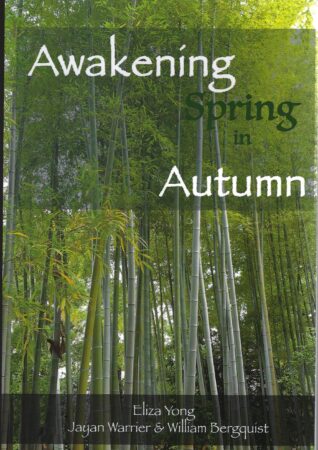

In this book, three psychologists (from different cultures) [Dr. Elisa Yong, Dr. Jayan Warrier, and Dr. William Bergquist] bring together an analysis of the Autumnal years based on different perspectives from the deep, introspective work (at many levels) in which all three are involved. They weave together mythic tales, classic poems and legendary stories from Western and Asian cultures to further illuminate and expand their exploration. Through this book, the authors seek to affirm the appropriateness of hopes and fears felt by those currently living in Autumn, as well as inspire those who are about to enter Autumn, and honor those who have been generative during these Autumnal years (and can now reflect back on these years with new insights). This is a book for everyone, be it a reader who is in autumn, summer, or winter. Be it for personal reading or for professional understanding, this book will be one to have in your hands.
With the graying of populations throughout the world, a book that provides intergeneration and cross-cultural perspectives on these years of Autumn would be welcomed—especially if these perspectives are being offered by both women and men. We are pleased to be able to offer this book with rich narratives and multiple insights, building on three historic narratives from three of the most influential regions on our world: Europe, Southeast Asia and India. Our book not only identified the challenges associated with the senior years of life, it also offers opportunities, actions to be taken and life-enriching changes to be made—hence the title “Awakening Spring in Autumn.” As the authors of this book, we come with a diversity not only of perspectives, but also of professional experiences. Our work ranges from that of personal psychotherapy to international corporate consulting and coaching. We also enter this writing enterprise with rich, inter-disciplinary expertise in such areas as literature, philosophy, and the arts. This expertise is evident in the many images we present and narratives we explore.
The analyses offered in Awakening Spring in Autumn span the many decades of senior adulthood. This is an important feature of our book, given that we now know that there are multiple stages of life even after 45. This has become increasingly apparent as men and women live longer lives. Instead of focusing on a specific decade of life or perpetuating the myths of a “mid-life crisis” and existential preparation for death after the mid-century, we focus on the diversity of life experiences during middle adulthood (45 to 65 years old)–biological, psychological and interpersonal. We know that everyone matures in their own unique way; yet all men and women around the world confront many of the same opportunities and challenges.
New Johari Window Why are some people interpersonally smart? Why do other people seem to be interpersonally challenged, if not downright stupid? Even more fundamentally, why are each of us sometimes geniuses and sometimes idiots in our interactions with people about whom we care deeply? Acknowledged as among the most insightful and useful models of human interaction, the Johari Window continues to be in high demand — yet nothing has been done to update the Johari Window since it was initially formulated more than 50 years ago. The New Johari Window, written by William Bergquist, provides the first new, expanded version of the Johari Window, fresh insights and useful concepts regarding human interaction, making use of now-classic concepts to be found in works written by a wide-ranging group of psychologists, psychiatrists and social analysts and incorporating recent findings from the fields of social-cognitive psychology, social-neurobiology and behavioral economics.____________________
Seal the Deal How do successful coaches and consultants make money and make a difference? You have to be good at networking, marketing and sales. That’s why Seal the Deal belongs on any new or experienced professional’s desk. It will help you avoid pitfalls made in all three of these key areas and increase your effectiveness. In this unique book, you’ll follow the conversations of author and master coach Suzi Pomerantz and several of her coaching colleagues. Get on the proven path to sealing more deals and succeeding in your business. Each chapter is a step in the author’s 10-step proven process for developing new business: · Demystifying selling and distinguishing networking, marketing and sales · The sales process, targeting prospects and branding · Calling prospects and setting up the first meeting · Handling gatekeepers and objections · The client meeting as a chess match · Following-up and tracking · Proposals, pricing and contracting · Networking · Lessons-learned meetings and expanding the sale while serving the client · Building business and the art of referrals Also included are worksheets, templates, samples and tip sheets; the tools anyone who sells services or ideas inside or outside the organization needs to build a successful business through clients and referrals. The book was an Amazon bestseller in 2007.
__________________



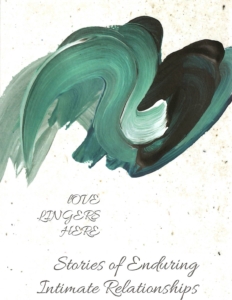
What is the nature of enduring love–and how do we find this type of love? Some valuable lessons are to be found in Love Lingers Here: Stories of Enduring Intimate Relationships. As the subtitle of the book implies, Love Lingers Here concerns enduring intimate relationships that exist in our mid-21st Century world.
Most books about couples are written by those doing couples therapy and are based on the assumption that successful couples are doing whatever the couples in therapy are not doing (called “pathological extension”). Love Lingers Here is based instead on interviews with more than 70 couples who have been together for many years (averaging 20 plus years together). Through thick and thin, these couples (both straight and gay) have remained loyal to one another and have found ways in which to adjust to changing conditions in their own lives and the world in which they reside.
Making use of a model of developmental stages, the author, William Bergquist, has described how his couples have found ways to remain in love over time. Dr. Bergquist introduces new concepts regarding relationship-based covenants, remarriages within a relationship, and marker events (differences that make a difference). Making use of a metaphor regarding the “tectonic plates” that move below the earth’s crust, Bergquist offers inspiring narratives regarding how specific “plates” in the lives of couples are engaged at each of their developmental stages. These plates relate to such critical issues as the couple’s finances, establishing a home, and raising children or initiating a shared project. Both troubling earthquakes and majestic mountains are created by enduring intimate couples when confronting these issues—much as earthquakes and mountains are created by earth-bound tectonic plates.
Finally, attention is given to very long-term relationships (from throughout the world) as well as the long-term relationship of some celebrity couples. A summary of the findings from this twenty-year study is provided for the benefit of those who wish themselves to establish and maintain enduring, intimate relationships—and find love that lingers with one another!