
Who doesn’t love books. The Library of Professional Coaching offers a bookstore that is filled with books on coaching that can be purchased at a very reasonable price. Here is a link to this bookstore:
Then there is the matter of getting these same books in digital form at no cost to you. And who doesn’t love free books? Due to the generous donations of these authors, you are able to download several entire books at no cost for the digital, PDF versions. Watch this space as we will add more books over time. You may wish to bookmark this page to return to for more free books.
_________________
Dancing Between the Raindrops: Polystasis, Character, and the Psychodynamics of Anticipation in a VUCA-Plus World
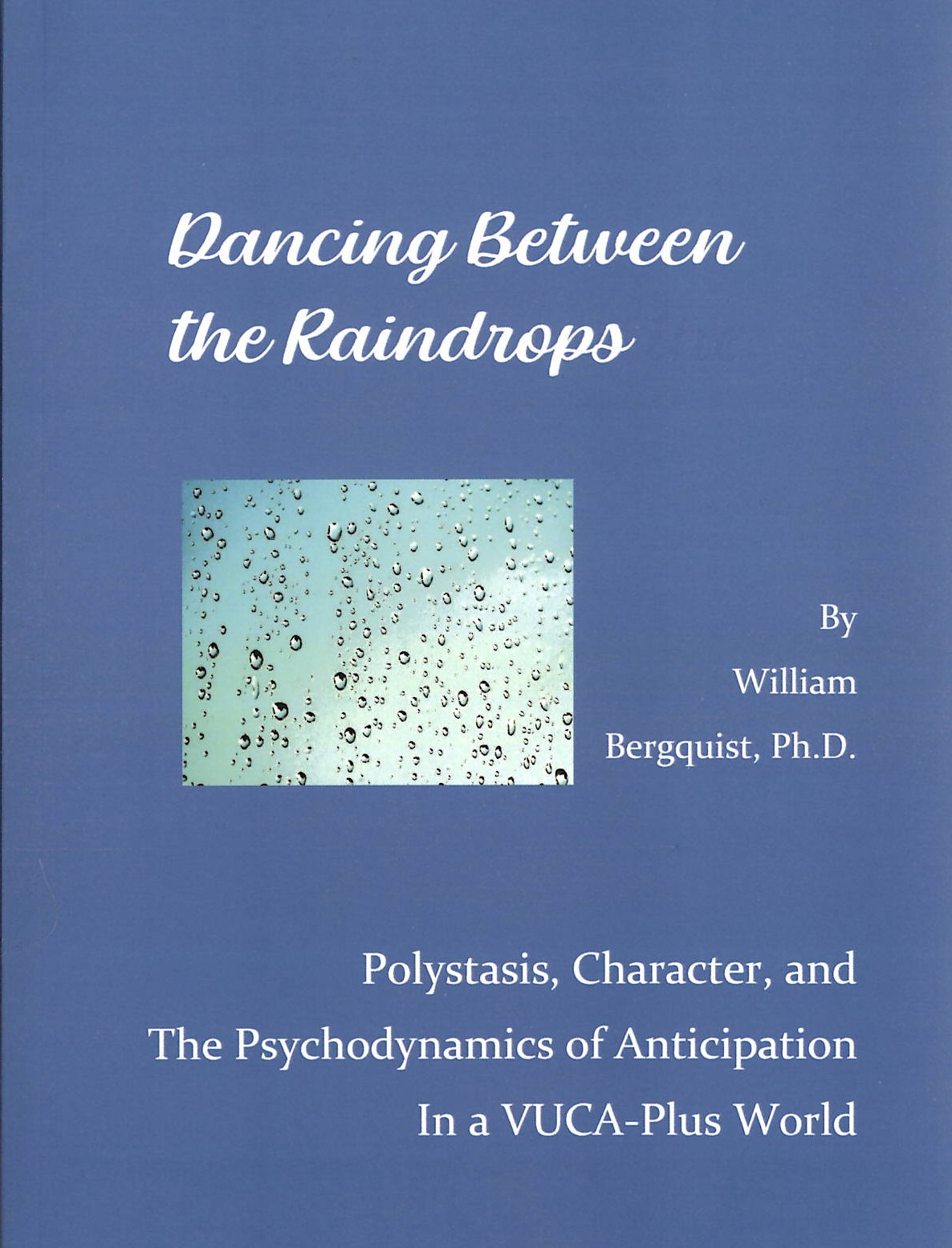 Author: William Bergquist, Ph.D.
Preview
We are living in a society that confronts us every moment with raindrop challenges—be they environmental, economic, or political. Somehow, we have to live and work around these challenges, rather than being trapped or frozen in anxiety and despair regarding the conditions in which each of these challenges now operates. Conditions such as volatility, uncertainty, complexity, ambiguity, turbulence, and contradiction.
In essence, complexity (C) concerns the many elements and dynamic interaction among elements that have to be considered, while Volatility (V) refers to the rate and shifting rate of change among the elements. The other two terms have to do with epistemology (acquisition of knowledge and definition of reality). Ambiguity (A) concerns the assessment of both the evidence available regarding reality and the meaning assigned to this reality. The fourth term, Uncertainty (U) concerns the stability of any assessment made about reality. Does reality change over a short period of time? Why do an extensive assessment if our world is constantly shifting? VUCA is deservedly becoming the coin of the realm among contemporary organizational and societal analysts.
I add two other conditions that are prevalent in mid-21st-century life. They are turbulence and contradiction (the “plus” in VUCA-Plus). Some things are rapidly moving, while others are engaged in cyclical movement under turbulent conditions. Other things are not moving at all or moving chaotically. The systemic Impact concerns the operations of a world in which four systems operate simultaneously. These four systems create the “white water” world prevalent in mid-21st-century societies (Vaill, 1989/2008). Navigation of a white-water environment requires an ongoing search for balance and direction, which in turn requires ongoing attention to the shifting conditions of this environment.
Contradiction is to be found at every corner of our mid-21st-century societies. We find this condition existing in contradictory advertisements for health-style remedies, romantic getaways, and many pathways to happiness. Even more profound sources of contradiction are found in politics and social policy. We often face a choice between two options, each with both an upside and a downside. Furthermore, the achievement of one is likely to reduce the achievement of the other. Our governmental leaders solve a major social problem. In doing so, they increase the national debt. The need for control of pornography on the Internet is great, but so is the need for an Internet that is free of constraints and values imposed by one group of “believers.”
In the rainy weather of mid-21st-century life, we face many difficult choices that often lead to negative outcomes in our personal lives and our collective lives.
I propose in this book that we can “dance” around these big raindrops by embracing a dynamic, feedback process that I have identified as Polystasis. Unlike the usual pull toward return to a state of homeostasis, I am proposing that we have the opportunity to live with and even survive in a state where the baseline is always changing (Poly-stasis), and where we are guided by a psychosocial template that provides us with guidance as we receive and respond to feedback from the VUCA-Plus world in which we are operating.
Polystasis blends the concept of Statics (stabilizing structures) with that of Dynamics (adaptive processes). Operating in human systems, we are guided by certain core outcomes that do not readily change (statics); however, we must also be open to modifying these guiding outcomes as our environment changes. The static notion of homeostasis is inaccurate—especially when applied in our VUCA-Plus environment. It is in our attunement to feedback arriving on an ongoing basis from the world in which we live that we can be adaptive and can “learn into the future” (Scharmer, 2009). We can anticipate the rain and prepare to dance around the raindrops . . .
As a psychologist who has been influenced by the Neo-Freudian theories of those aligned with ego psychology and those operating from an object relations perspective, I believe that Polystasis involves both the brain and heart. Both cognition and emotions. The interweaving of thinking and feeling. I am particularly intrigued with the recent “discovery” that regret might be a more motivating emotion than either gain or loss. We try to avoid making any decision that we will later regret. We hate to miss an “opportunity” or to shrink from taking bold actions. For example, a sports fan would rather watch a game that their team loses than fail to watch the game. While witnessing a win is most gratifying, witnessing a loss is preferred to not witnessing the game at all.
From a polystatic perspective, the avoidance of regret would be motivated by painful anticipation of some beneficial event or experience of which we have failed to avail ourselves. We can imagine hearing about a game after it is over and wishing that we were there. Second-hand accounts are rarely satisfying. We might even be annoyed that someone other than us was at the game and doing the recounting.
We can apply the polystatic perspective to matters of potentially greater importance. Do we accept the invitation to participate in a meaningful discussion at our company’s or community’s decision-making table? We can anticipate our feelings of being left out if we don’t attend. What if the decision was to do something of which we don’t approve? Regret-filled emotions would course through our mind, body (and soul) alongside feelings of guilt and/or annoyance regarding the decision that was made. We must attend the meeting, even if we anticipate that it could be boring or that our input will be ignored. Other priorities are set aside just so we have no regrets regarding the meeting. We don’t want the rain to fall as we sit outside the meeting room. . . .
________
 The New (Ab)Normal: Radical Perspectives and Practices in a VUCA-Plus World
 The New (Ab)Normal: Radical Perspectives and Practices in a VUCA-Plus World
Author: William Bergquist, Ph.D.
This book concerns six challenging mid-21st-century conditions (VUCA-Plus) and some unique ways in which to view and act upon these challenges. The author, William Bergquist, will be viewing each of these challenges from several different perspectives in this book, offering several distinctive strategies for addressing these challenges. In essence, the condition of complexity (C) concerns the many elements and dynamic interaction among elements that have to be considered, while Volatility (V) refers to the rate and shifting rate of change among the elements. The other two conditions have to do with epistemology (acquisition of knowledge and definition of reality). Ambiguity (A) concerns the assessment of both the evidence available regarding reality and the meaning assigned to this reality. The fourth condition, Uncertainty (U) concerns the stability of any assessment made about reality. Does reality change over a short time period? Why do an extensive assessment if our world is constantly shifting?
Bergquist adds two other challenges: turbulence and contradiction. They are both interwoven in the fabric of VUCA. They each add a further layer to the challenge we now face in our mid-21st-century society. Furthermore, turbulence and contradiction often pair up with one or more of the other VUCA conditions to add even more weight to the mid-21st-century burden. Some things are rapidly moving, while others are engaged in cyclical movement under turbulent conditions. Other things are not moving at all or moving chaotically. The systemic Impact concerns the operations of a world in which four systems operate simultaneously. These four systems create the “white water” world prevalent in mid-21st-century societies. At a personal level, navigation of a white-water environment requires an ongoing search for balance and direction, which in turn requires ongoing attention to the shifting conditions of this environment.
Contradiction concerns the frequent presence of radically different constructions and interpretations of reality—and the differing meanings assigned to the constructed reality. Contradiction is perhaps the most soul-wrenching of the six VUCA-Plus conditions. Valid and useful messages are delivered to us every day. However, they often point in quite different directions. It is even more challenging to recognize that each side of the contradiction often needs the other side to exist to find direction and energy. Bergquist pushes the consideration of Contradictions a step further by suggesting that contradictions are often polarities. The systemic impact of Polarities and Contradictions centers on the credibility of advice being offered by people and institutions that can be trusted. Credibility is being challenged because the advice one trusted source offers is often inconsistent with the advice offered by a second trusted source. When we bring in dynamics associated with polarities, then we are likely to discover that advice offered by the second source is often triggered by the first source.