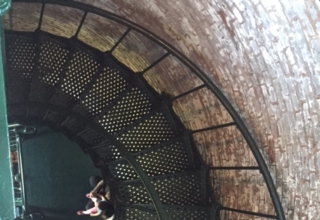
In essence, this form of micro-coaching provides clients with the opportunity to view the issues they are addressing during their coaching sessions from a distance. An Interlude filled with distal (distant) perspectives in time or space can yield great insights. The noted philosopher and leader, Marcus Aurelius, put it this way (Robertson, 2019, p. 261):
“. . . anyone seeking to understand human affairs should gaze down upon all earthly things . . as though from a high watchtower. Each day I would rehearse, just as my teacher [Plato] did, imaging myself suddenly raised aloft and looking down on the complex tapestry of human life from high above.”
From above, with the assistance of a coach, we can discern patterns of our own behavior, patterns of other people’s behavior, and patterns of life events. Our proximal (close) view that concerns moment-to-moment adjustments is set aside on behalf of broader purposes and longer-term goals. We are also likely to find that the view from these heights reveals a world that is not all white and black nor all right and wrong. As Paul Watzlawick (1986, pp. 38-39) revealed:
“. . . there is something fundamentally wrong in assuming that the opposite of bad must be good—and not just because the good is not yet good enough or because the bad has not yet been totally exterminated.”
At these heights, we become relativists (Perry, 1970), discarding our dualism. We discover that both goods and bads are to be found in our current condition. No one solution is all good or all bad. In accordance with Watzlawick, we come to acknowledge that it is not enough to eliminate the bad in our lives; we must also find a way to construct a compelling and comprehensive good, which often includes something of the bad that we had hoped to abandon in our lives.
For instance, from a distal perspective, we find that our working relationship with that person, whom we just asked to leave our team, was a source of great insight for me regarding how to confront someone assertive. Or we discover that there is a pattern in our work life. We move on to a new job every two to three years. While it is a “pain” to keep packing up and moving to a new job, we have been able to bring what we have learned from the old job to our new job. Furthermore, we have been able to move from job to job because we keep getting recruited to a new position, based on our ongoing improved performance. Good (improved performance and job upgrade) is mixed in with the bad (unsettled life). As William Bridges (Bridges, 1980; Bridges, 2001) repeatedly noted, a successful transition to a new place in our life requires that we acknowledge what was beneficial in the old place. We must grieve what we have left behind (and bring some of it with us to our new life) if we are to successfully transit into the new.
Message from Olympus
There are a variety of ways in which we can provide a bit of Stoic coaching. We can construct an Interlude in which we encourage our clients to reflect from a distance by making use of metaphors, analogies, parables, and/or similes (Bergquist, 2021). As a coach, we tell a story related to our client’s current condition. This allows our client to look beyond and above their current, often siloed, viewpoint. In an Interlude of Metaphors, I often envision my client receiving a message from the gods on Olympus. This “message” can come in the form of an event occurring in my client’s life, or a disturbing interaction with some other person. At times, the message can even come from a dream, play, piece of music, or book that somehow has recently delivered a strong emotional “punch” in my client’s guts. Paul Watzlawick (1986, p. 24) would seem to agree, telling a tale about a man:
“. . . for whom there was a new feeling towards the world and his own life; he had a longing for something he vaguely called happiness, harmony, being in tune, something that he experienced in curious moments when he was incomprehensibly touched by music or seemingly quite trivial experiences.”
Download Article